
In a digital-first world, engineers can research products, compare specifications, and connect with suppliers without leaving their desks. So, are industrial trade shows still worth attending?

In a digital-first world, engineers can research products, compare specifications, and connect with suppliers without leaving their desks. So, are industrial trade shows still worth attending?
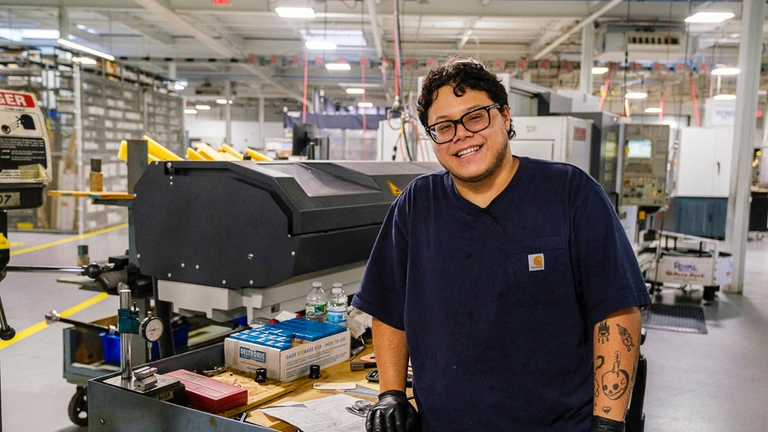
While college is a traditional pathway for many, it's not the only route to a lucrative and fulfilling career. In fact, several alternatives offer high earning potential, job satisfaction, and opportunities for personal growth without the hefty investment of time and money that a four-year degree often requires.
Rising College Tuition and the Debt Trap.

In The Autobiography of Benjamin Franklin, he lists thirteen virtues “all that at that time occurr’d to me as necessary or desirable.”

Skills are assets, and they are how most people make a living. We go to school, learn a trade, acquire experiences and then give our time in exchange for money. The amount of money we earn for our time is most likely (but not always) a direct reflection of the “market value” of our skillsets—traditionally speaking. It’s true, “time is money,” but it makes just as much sense to say, “skills are money.” Luckily, obtaining a skill is quite simple in terms of cognitive processing. All one needs is motivation, the ability to learn, and time for practice.

After studying 24,000 people in more than two dozen organizations, three authors (David Logan, John King, and Halee Fischer-Wright) outlined some innovative, science-based leadership models. Their 2008 book, Tribal Leadership: Leveraging Natural Groups to Build a Thriving Organization, Logan et al., concluded that a company’s success depends on the strength of its “tribes.”

Skills are assets, and they are how most people make a living. We go to school, learn a trade, acquire experiences and then give our time in exchange for money. The amount of money we earn for our time is most likely (but not always) a direct reflection of the “market value” of our skillsets—traditionally speaking. It’s true, “time is money,” but it makes just as much sense to say, “skills are money.” Luckily, obtaining a skill is quite simple in terms of cognitive processing. All one needs is motivation, the ability to learn, and time for practice.

Think back to your first couple of semesters as an engineering student. You were flooded with new concepts. Likely, the mathematics were more difficult than anything you had encountered in high school, and you worked around the clock to absorb it all. But you knew some of the difficulties when you applied for school in the first place. The challenges weren’t a mystery to you, and something drove you to take them on. Becoming an engineer is a big, challenging goal that many people are not ready to accomplish or could not, even if they tried.

The age-old debate of whether leaders are born or made through experience was mostly solved on March 16, 1802 when the United States Military Academy at West Point was founded. The academy’s goal was to develop leaders of character for a lifetime of serving the nation, and by all measures the academy was a success.

Most people understand that the pace of change is speeding up globally, along with the demand for more innovation. In a little more than 100 years, technological development has taken us from the first telephone call in 1876, to the first website in 1991. A mere 16 years elapsed between the appearance of the Internet and the first iPhone (2007). Since then, significant technological breakthroughs are happening each year.